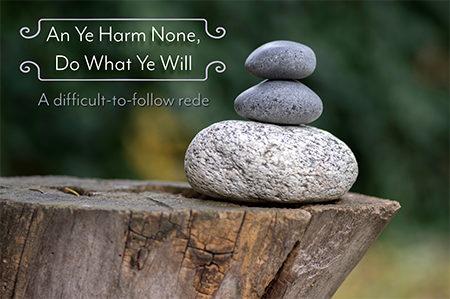
At first glance, it seems really simple: as long as you are not harming anyone else, there is no limit, no rule, no doctrine to what you are allowed to do and how you should do that.
But if we start to delve a little into the possible interpretations of this guide, we may find ourselves looking at the infinite depths of conditional circumstances.
How do we define an absolute definition of what it means to be a harm to someone? What we - based on our current moral guidelines, our knowledge and experience of the world - consider to be right and harmless, may be downright harmful to someone else. Do not do to someone else - without their explicit request - what you would wish for yourself, because they may have different tastes.
Or perhaps it should be understood as "we should not be motivated by harmful intentions during the course of our action"s. Is it the intention that is relevant?
After asking the question, "what does it mean to be a harmful to someone else?", another question arises, "who or what is it that we must avoid harming?"
Do we have to follow this rule only with regard to our fellow human beings, or does it apply to animals, plants, minerals, all elements of nature, rivers, the ozone layer, the air, the water and the Earth itself?
If we consider the Earth to be a living organism, a system of infinite variety of interacting elements, then every single thing that exists in the world can be considered to have the right not to be harmed.
But the very fact of being alive brings destruction, because to sustain the human body we need to feed, and in feeding we destroy other things that exist and take their useful elements. Then, as our current life story comes to an end, our bodies are returned to a more natural cycle and continue to nourish life on earth. From destruction and decay comes life again.
Consider what you do before you act, assess the possible consequences, weigh up the potential harm your actions could cause, think about whether the expected gains are worth the losses caused by your actions. - Is this perhaps the correct approach?
What about those situations when we don't know we are going to cause harm (or have already caused harm). The unpredictable situations, the ones we couldn't have avoided even with our best intentions? We assess the situation beforehand, we take all precautions, but the chain of events can cover such a wide spectrum, in space and time, that it is an impossible challenge to foresee all the possible scenarios.
There may be times when we do not cause "real" harm, but someone may still consider that their interests have been harmed, and they feel that we have caused them real harm. It's the feelings that matter, how you feel about the situation, is that the key?
We can also find ourselves in a crucial situation where we are aware that our actions will harm someone else, but we see no other way out, because if we do not act, we will suffer irreparable damage. In such a situation, whose interests have priority over the other's? In a life-saving situation, can I ignore this rule? If so, under what conditions and to what extent?
If we take the harm "none" (anyone) part literally, then that includes oneself as well. What if we are doing magic where we know we will suffer some loss, but in the bigger picture what we are doing is beneficial?
Furthermore, we may have an even more fundamental question: should we abide by this rule at all? Because there are, for example, magical workers who do harmful magic, and they do it consciously, considering the consequences.
I do not intend to answer the questions "How exactly should this be interpreted?" or "Should we follow this advice?".
Rather, I suggest that we approach it in a different way: as a kind of "initiatory conundrum". A riddle for which there is no definitive answer that someone else could tell us, because we have to unravel the depths of the question ourselves.